
Anouk van Veldhoven is a PhD candidate in Economics at Utrecht University School of Economics. Her research aims to answer economic questions related to gender, health and development, such as intra-household decision-making and information sharing, intimate partner violence, and women’s reproductive health.
1 in 3 women globally report to have ever experienced any physical or sexual violence perpetrated by their partner (WHO, 2018). Theories of intimate partner violence (IPV) in economics relate IPV to changes in women’s economic resources or opportunities (e.g., Farmer and Tiefenthaler, 1997; Bloch and Rao, 2002; Aizer, 2010; Bobonis et al., 2013; Calvi and Keskar, 2023). However, these theories generally lack empirical support and fail to account for the high rates of repeated physical abuse observed worldwide (Bulte and Lensink, 2019; Guarnieri and Rainer, 2021; Bergvall, 2024).
In contrast, violence research in public health and psychology has emphasized that IPV often arises in the context of interpersonal disagreements, particularly over emotionally or financially salient household decisions — such as finances, children and social activities (e.g., Kernsmith, 2005; Murphy et al., 2005; Hettrich and O’Leary, 2007). From this perspective, IPV is described as a breakdown in conflict resolution, where arguments escalate, and perpetrators lose control.
In the paper Keeping the Peace While Getting Your Way (with Dan Anderberg, Rachel Cassidy, Anaya Dam, Wendy Janssens and Karlijn Morsink), we formalize this alternative conceptualization of IPV in an economic theory of strategic communication about household decisions that are made under incomplete information. Our framework endogenizes IPV as the outcome of disagreement and strategic communication between partners. We test the predicted IPV impacts of the arrival of new information in a case study.
Theoretical innovation: Persuasion may reduce disagreement and IPV
When partners have different preferences about an important household decision, and new information becomes available to one partner only, they may strategically frame or distort the information towards their spouse, to align the final decision with their own preferences. We model this behavior as Bayesian persuasion, in which the uninformed partner updates their beliefs rationally, accounting for the possibility of misrepresentation of the information by their spouse.
Strategic representation of information – or persuasion – by a privately informed partner will thus create more agreement around their preferred decision outcome. This potential for persuasion is eliminated when both partners are informed. Hence, the model predicts that the likelihood of disagreements, and thereby IPV, will be highest when both spouses are informed, as neither has an informational advantage to influence the other and forge agreement.
Importantly, the overall impact of information on IPV relative to a no-information baseline is ambiguous: information may resolve disagreements in some households and induce disagreements in others.
Case study: parental decisions over daughters’ marriage timing
We test the prediction in a case study, leveraging an existing randomized controlled trial (RCT) of an educational entertainment (edutainment) intervention about girl child marriage in rural Pakistan. In this context, marriage of daughters is a high stakes household decision that parents make jointly. Parents trade-off potential returns to delaying marriage – of which the likelihood is uncertain – with potential costs from deviating from local social norms that favor early marriage. Mothers are less willing to deviate from these norms than fathers. As a consequence, mothers and fathers may disagree over whether or not to delay their daughter’s marriage.
The edutainment intervention is a mobile cinema screening of a locally developed street theatre performance. The play presents a narrative that explores the costs and benefits of delaying a daughter’s marriage, with characters embodying a range of individuals that are typically involved in marriage decisions. Group discussions followed the screening.
The 177 participating villages were randomly assigned to one of four arms:
- Control group (C) – no intervention.
- Female arm (F) – only mothers received the intervention.
- Male arm (M) – only fathers received the intervention.
- Female + Male arm (F+M) – both parents jointly received the intervention.
We use survey data from both parents on marriage beliefs and outcomes, and from mothers on their experiences of IPV, collected at baseline and 6 months (midline) and 18 months (endline) after the intervention. All IPV data collection carefully followed WHO ethical protocols (WHO, 2016) to ensure women’s safety and confidentiality.
Beliefs about marriage delay returns: fathers persuade mothers
To capture perceived returns to marriage delay, we elicit parents’ beliefs about the educational attainment of their daughter’s future spouse, conditional on her age at marriage. Figure 1 shows fathers’ and mothers’ expected likelihood that the daughter’s spouse will have completed secondary or high school (y-axis), if she marries at age 16, 18 or 20 (x-axis). Both mothers and fathers perceive a positive relationship between their daughter’s age-of-marriage and the education of her future spouse, even in the control group. Both parents also update their beliefs positively in response to the intervention in all treatment arms. This suggests a pre-existing awareness of returns to marriage delay, which the intervention reinforced.

Crucially, belief updating by mothers is highest when only fathers are targeted in the Male arm. This suggests that privately informed fathers engage in persuasion by strategically exaggerating the benefits of marriage delay when communicating with mothers. We find that this is particularly pronounced for households where parents differ most in their preference for adhering to social norms that favor early marriage. In those households, we would indeed expect the strongest incentives for persuasion. We find no comparable evidence of persuasive behavior by mothers when they alone are treated.
IPV most likely when both partners receive new information
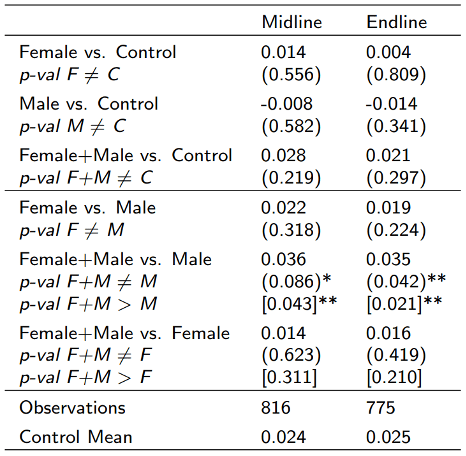
We test our model’s central prediction: that IPV is more likely to occur when spouses are jointly targeted in the Female+Male arm, as compared to when spouses are individually targeted in the Male arm or the Female arm. Table 1 presents treatment effects on the rate at which mothers experience physical IPV.
At both midline and endline, we observe the highest rate of IPV in households where both parents received the intervention. The observed endline IPV incidence rate in the Female+Male arm is 1.6 percentage points higher than in the Female arm, and 3.5 percentage points higher than in the Male arm. For reference, the IPV rate in the control group at endline is 2.5%.
The difference between the Female+Male and Male arm is statistically significant, while the difference between the Female+Male and Female arm is not. This pattern is consistent with our earlier finding that fathers – more so than mothers – forge agreement through persuasion when they alone hold the information advantage.
Heterogeneity analysis further shows that these effects are driven by couples who differ most in their preference for adhering to social early marriage norms, precisely where persuasion might have resolved conflict had only one partner received the information.
We rule out alternative explanations for the higher rate of IPV in the Female+Male arm. Hypotheses such as male backlash to women’s participation in the intervention, increased discussions, increased involvement of mothers in the decision, or veto-power by both parents are not consistent with our full set of empirical findings.
Conclusion and policy implications
Our model and empirical findings suggest that who receives new information in the household matters greatly for household disagreement and IPV. Disagreements about important household decisions that cannot be navigated through persuasion may escalate into conflict, including IPV. In contrast, strategic communication by a privately informed partner can sometimes prevent conflict.
This calls for careful consideration of targeting strategies and supplementary IPV mitigation strategies when implementing interventions that address high-stakes household decisions.


